Carbon removal

Mangrove restoration project in Myanmar

Mangrove restoration project in Myanmar

Why support this project?

The Worldview International Foundation (WIF) is a restoration project within Myanmar that aims to remove carbon through mangrove afforestation and its associated benefits for soil organic carbon accrual, restoring local ecosystems. This project is largely based in the state of Ayeyarwady and is largely successful due to the extensive collaboration with local communities. We support this project due to the exceptionally strong benefits for the community and biodiversity. Mangroves are rich in biodiversity and provide habitat, nursery grounds, and food for a wide array of species, including birds, fish, and invertebrates. This biodiversity supports fishers and contributes to the health of adjacent ecosystems, such as coral reefs and seagrass beds. This project is of great importance as Myanmar currently operates with no effective environmental projections. A focus on community is central to the success and design of this project. There is a strong focus on community engagement throughout the design, implementation and ongoing measures of the project, as land-right holders, the communities directly influence the core project activities, including the planting locations.

What is blue carbon?

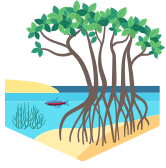
Blue carbon is the carbon held in coastal habitats, including mangrove forests and seagrass meadows. These ecosystems absorb carbon as they grow and can store it in the sediments beneath them. Protecting and restoring them supports long-term carbon storage, while providing nurseries for marine life and helping protect shorelines from erosion.

Project summary

The Worldview International Foundation (WIF) is leading a large-scale reforestation project in Myanmar’s Ayayarwady Division. This project aims to restore 2,146 hectares of degraded mangrove land over 20 years. Centered in Shwe Thaung Yan Township, the initiative targets carbon sequestration, biodiversity conservation, disaster risk reduction and poverty alleviation. The project includes community training, sustainable livelihood development, and mangrove genebank establishment. Key partners include local universities, government bodies, and conservation committees. Over 9 million trees are to be planted, with an estimated 3.68 million tCO2e sequestered. It complies with national and international environmental standards, while also incorporating local engagement and leakage prevention measures.

However, the loss of these habitats causes increasing vulnerability to natural disasters. The loss and/or erosion of coastlines can lead to loss of life, and economic costs. 

As one of the most efficient natural carbon sinks in the world mangroves restoration aids in the removal of carbon from the atmosphere. The WIF project is achieving a 90% survival rate of planted mangroves. This is achieved through planting techniques that closely follow the natural regeneration cycle of mangroves. Through innovative harvesting and planting techniques, WIF has found a method which greatly supplements the area in which they are planting.

Locations

Myanmar

Timeline

Follow the latest milestones and updates from this project.

Jun 2025

Completion of 6th Verification

  • EcoLance Pvt. Ltd. issued Verification Report EPL-VCS-2024-0014 for the monitoring period from Jun 15, 2022, to Dec 31, 2023
  • Verified net GHG emission reductions of 94,444.67 tCO2e and net removals of 78,389 tCO2e after buffer pool deductions
  • Reconfirmed adherence to VCS Standard v4.7 and CDM methodology AR-AM0014 Version 03.0
Nov 2023

Verra Approval of 5th Verification & Methodological Alignment

  • Verra finalised the Project Review Report, approving the 5th verification conducted by Earthood Services Pvt. Ltd.
  • Issued a Forward Action Request (FAR) requiring full alignment with both ARR and WRC (Wetlands Restoration and Conservation) project categories under VCS Standard v4.3.
  • Mandated a 10-year baseline reassessment and transition to VM0033 methodology upon baseline reassessment
Nov 2021

Completion of 4th Verification

  • 4K Earth Science Pvt. Ltd. issued Verification Report 2107-VCS for the period from Jun 15, 2020, to Jun 14, 2021
  • Certified 54,137 tCO2e in net emission reductions after a 10% buffer deduction
Jan 2021
Establishment of Myanmar's only mangrove gene bank

Establishment of Myanmar's only mangrove gene bank

  • The gene bank initiative brings together WIF, Pathein University’s Marine Research Centre, Myeik University, and the Ministry of Environmental Conservation and Forestry, combining conservation practice with academic expertise. Under the leadership of Professor Dr. San Tha Tun, with support from PhD candidate Htoo Lwin Aung and Professor Dr. Aung Htay, the Gene Bank serves as a living archive for species that are vital to research and restoration efforts.
  • This provides the safeguarding of over 50 species for research restoration and future generations. This includes the critically endangered Snonneratia griffithii and Bruguiera x hainesii species.
Oct 2020

Completion of 3rd Verification

  • 4K Earth Science Pvt. Ltd. issued Verification Report 2011-VCS for the period from Jun 15, 2019, to Jun 14, 2020
  • Verified net GHG emission reductions of 53,369 tCO2e generated over the 1-year monitoring period following 10% buffer deduction
Oct 2019

Completion of 2nd Verification (2018–2019)

  • TÜV SÜD South Asia Pvt. Ltd. issued Verification Report No. 10502MO for the period from Jun 15, 2018, to Jun 14, 2019
  • Verified 26,615 tCO2e in net emission reductions after applying a 10% buffer pool deduction
Oct 2018

Completion of 1st Verification (2015–2018)

  • RINA Services S.p.A. issued the 1st Final Verification Report for the monitoring period from Jun 15, 2015, to Jun 14, 2018
  • Certified a total net anthropogenic GHG removal of 31,744 tCO2e across 2,146.48 ha
  • Confirmed phased planting execution across Magyi (737.04 ha), Thabawkan (887.87 ha), and Thaegone (521.57 ha)
Feb 2018

Publication of Registered Project Description

  • Worldview International Foundation issued Version 3.0 of the VCS Project Description
  • Defined the target restoration boundary of 2,146.48 ha with an estimated net removal of 3.68 million tCO2e over 20 years
  • Formally structured implementation partnerships with Pathein University, local village tract conservation committees, and the Myanmar Forest Department
Jun 2017

Initial Project Validation Completed

  • Independent validation was concluded by validation body RINA Services S.p.A. for the initial two-year period from May 15, 2015, to Jun 26, 2017
  • Established project compliance under the Verified Carbon Standard (VCS) and Clean Development Mechanism (CDM) methodology AR-AM0014 Version 03.0.
May 2015

Project Inception and Land Preparation

  • Land preparation activities commenced in the Magyi, Thabawkan, and Thaegone village tracts within ShweThaung Yan Township, Ayeyarwady Division, Myanmar
  • Project proponent Worldview International Foundation (WIF) formally established this date as the official project start date

Benefits

Climate

Mangrove forests are highly efficient at sequestering carbon dioxide, making them crucial in the fight against climate change. They store carbon both in their biomass and in the sediment below their roots. The mangrove absorption rate of carbon dioxide is 10 times higher than terrestrial forests. Through the reforesting and regenerating degraded lands the expected carbon removal across the project period is 3,680,125 tCO2e. The long-term lease on the project area extends far beyond the 20 year project period. With a legally binding option to continue the project for a further 90 years; 120 years in total. What an incredible amount of carbon could be removed over this extensive period of time.

Nature

In a bid to preserve Myanmar's mangrove biodiversity, in 2021 the WIF project established Myanmar's only mangrove gene bank. This gene bank safeguards over 50 species for research, restoration and future generations. The bank holds unique value for conserving species diversity in a region where many mangroves face increasing pressure from climate change and coastal development. The innovation brings together Pathein University’s Marine Research Centre, Myeik University, and the Ministry of Environmental Conservation and Forestry, combining conservation practice with academic expertise.

This project aims to plant over 9 million trees. This increase in mangrove forest density is extremely beneficial for this coastal ecosystem. The established plants have a complex root system that filters and traps pollutants, sediments, and heavy metals, improving water quality flowing into the oceans. While acting to maintain water quality and diffuse wave action that could cause erosion, mangroves are a very resilient species. Mangroves are resilient to harsh conditions, such as high salinity, extreme tides, and low oxygen levels in their soils.

People

WIF has a primary goal to regenerate ecosystems and strengthen the foundations of resilience. WIFs work grows partnerships with 16 coastal villages, restoring forests while also building long-term resilience and opportunity. Communities are deeply involved in the decisions behind community projects and benefit provisions. Projects start with village consultations and socioeconomic surveys to establish priority needs. The project has a well established benefit-sharing mechanism in place, with an allocation of 50% of carbon revenue to the community through sustainable development projects; decided by the community. The project has provided cookstoves, silviculture training, and basic english and computer classes. The project has positioned 43% of the leadership roles to be completed by women within community initiatives. Across the WIF restoration and stewardship activities over 3,000 seasonal and local workers are employed.

SDGs supported

Zero Hunger

The project provides basic food items (rice, cooking oil, onion, potato, egg and beans) to 597 vulnerable households affected by the economic crisis and global pandemic. It also provides nutritious food to vulnerable households who is suffered more pressure on the resources due to natural disasters and global pandemic, etc. The project aims to increase the number of local people who improved skills, including technical, and vocational skills for employment and entrepreneurship and more production field on agricultural and aquacultural sectors.

Quality Education

Increased the access to educational facilities by the school children in 20 school in the project areas 100 % of school in project targeted villages are covered. The project supports school multimedia equipment, solar panel & battery set, solar lamps, school items (books and umbrella), raincoats, and teaching materials such as school desks & chairs, and whiteboard to all targeted schools in the project area. 8 teachers were received monthly teacher salary under scholarships program. Total 525 students have benefitted from providing 8 teachers in three targeted area schools.

Gender Equality

43% of women are positioned in leading roles in the village development committee in the targeted villages.

Clean Water and Sanitation

With contribution of community, 1 sub-projects supported well excavation and fencing in one targeted village in project area to access safe drinking water. 100% of population in one targeted village is covered.198 peoples received four clean hygiene awareness which covered 686 population for promoting their personal hygiene and sanitation in three targeted villages and provided hygiene & sanitation items (soap, tooth paste, tooth brush, bowl, nail clipper and plastic bucket).

Affordable and Clean Energy

The project supports the financial to access the electricity within the villages. The total of 3,036 People (100% of population) from three project villages are covered and the people have accessed the electricity for their education and other livelihood sector.

Industry, Innovation and Infrastructure

With contribution of community, the project has supported 6 infrastructure projects on promoting the access the smooth transportation, for better drainage and to protect the agricultural land, houses and people from flooding in five targeted villages. The 6 projects are 1 box culvert construction, 2 drainage construction, 2 bridge constructions, 1 school roof repairing and those projects covered 100% of population in five targeted villages.

Climate Action

The project has avoided the emissions of 340,744 tonnes of carbon into the atmosphere from 2015 to 2023. Mangrove restoration will reduce the numbers of local people which can be affected from future coastal storms.

Verification

These partners help deliver the project and verify its impact.

Suppliers

Worldview International Foundation

WIF develops high-integrity mangrove restoration projects that bring global climate goals and local priorities together regenerating ecosystems, building with communities, and generating verified carbon credits.

Verifiers

Verified Carbon Standard

The Verified Carbon Standard (VCS) Program is the world's most widely used greenhouse gas (GHG) crediting program.

View evidence
Climate, Community and Biodiversity Standard

Projects developed under the CCB Program must follow a rigorous assessment process to be certified. The CCB Standards are managed by Verra but were developed through a multi-stakeholder process by the Climate, Community & Biodiversity Alliance, a partnership of CARE, Conservation International, The Nature Conservancy, the Rainforest Alliance and the Wildlife Conservation Society.